October 15, 2026
There is no city in the world like Varanasi.
Not in Asia. Not anywhere. Varanasi is the oldest continuously inhabited city on earth, possibly 3,000 years old, older than Rome, older than Athens, older than Jerusalem as a living sacred city. It has been a centre of Hindu learning, worship, and pilgrimage without interruption for longer than most civilisations have existed.
It is also loud, crowded, chaotic, and confronting in ways that no amount of prior reading entirely prepares you for. The cremation fires on the ghats burn day and night without pause. The lanes of the old city are medieval in their narrowness and their vitality. The Ganga at dawn, when the pilgrims descend and the priests perform their rituals and the smoke rises from the burning ghats, produces an image so far outside the visual vocabulary of most Western visitors that it takes time to process.
For premium international travellers who give it that time, Varanasi consistently delivers the most powerful experience of their entire India trip.
This guide covers everything you need to know before you arrive.
Why Varanasi
Varanasi does not appear on every India itinerary. Some premium travellers, particularly those on shorter trips, skip it in favour of Rajasthan’s more visually polished experiences or Kerala’s more comfortable pace.
This is almost always a decision they regret.
Varanasi is where India’s philosophical, spiritual, and cultural depth is most concentrated and most visible. The city’s relationship with death, which is neither hidden nor sanitised here but handled in full public view as an entirely natural part of daily life, produces a quality of reflection that few other travel experiences in the world generate.
Hindus believe that dying in Varanasi guarantees moksha, liberation from the cycle of birth and death. This belief has drawn the dying here for centuries. And it has produced a city whose entire existence is organised around the most fundamental questions of human life, what we are, why we are here, and what happens when we leave.
Engaging with that, even briefly and imperfectly, changes how you see things.
Understanding Varanasi Before You Arrive
The Ghats
The ghats are Varanasi’s defining feature, 88 sets of stone steps descending from the old city to the western bank of the Ganga, running for approximately 7 kilometres along the river. Each ghat has its own character, its own function, and its own history.
Most ghats are bathing ghats, used by pilgrims for ritual bathing in the Ganga at dawn, the act of touching the sacred river considered purifying and auspicious. The bathing culture of the ghats is one of the most ancient continuously practised rituals in the world.
Two ghats are burning ghats, Manikarnika and Harishchandra, where cremations take place continuously, day and night, 365 days a year. The cremation fires at Manikarnika have reportedly been burning without interruption for centuries. Approximately 200 bodies are cremated here daily.
Understanding that the cremation ghats are not a spectacle but a sacred site, where families bring their dead believing they are performing the most important religious act of their loved one’s life, is the foundation of approaching Varanasi with appropriate respect.
The Old City
Behind the ghats, Varanasi’s old city is a medieval labyrinth. The lanes, called galis, are so narrow that two people cannot always pass comfortably. They are covered in prayer flags, marigold garlands, cow dung, flower offerings, and the accumulated layers of centuries of urban life. They contain temples, chai stalls, silk weaving workshops, flower markets, classical music schools, sweet shops, and the homes and businesses of families who have lived here for generations.
Navigating the old city without a guide is genuinely disorienting. Navigating it with a guide who knows the lanes, the history, and the specific stories of specific buildings and families is one of the finest walking experiences available anywhere in India.
The Ganga
The Ganga at Varanasi is not clean by conventional standards. It is, however, considered the most sacred river in Hinduism, the physical embodiment of a goddess, and its relationship with the city that has worshipped on its banks for 3,000 years is unlike the relationship between any other river and any other city in the world.
The visual quality of the Ganga at Varanasi, particularly at dawn and dusk, when the light is extraordinary and the river carries the reflections of the ghats on both banks, is one of the finest in Indian travel.
What to Do in Varanasi
The Dawn Boat Ride
The single most important experience in Varanasi is a boat ride on the Ganga before sunrise.
Book a private shikhara, a narrow wooden boat, for your group. Depart from Dashashwamedh Ghat or Assi Ghat before 5:30am. Move slowly along the ghats as the city wakes.
What you see in that hour: the priests beginning their pre-dawn rituals on the ghats in the darkness. The first pilgrims descending to the water, their figures silhouetted against the slowly lightening sky. The cremation fires on Manikarnika Ghat burning with the same continuity they have maintained for centuries. The flower offerings floating on the dark water. The sky moving from black to deep violet to gold.
This is Varanasi at its most distilled, the entire city’s purpose concentrated into a single hour of extraordinary visual and sensory intensity.
A private boat with a knowledgeable guide who can explain what you are witnessing, the specific rituals, the history of individual ghats, the stories of the families who have maintained these traditions across generations, transforms the experience from observation into understanding.
The Ganga Aarti
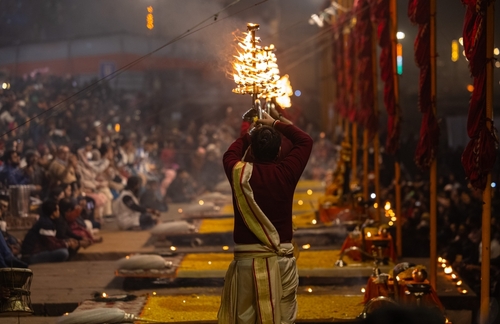
Every evening at sunset, a team of priests performs the Ganga Aarti at Dashashwamedh Ghat, a ceremonial offering of fire to the river, using large brass oil lamps that are swung in elaborate choreographed patterns to the accompaniment of drums, conch shells, and chanting.
The ceremony has been performed daily for decades. It draws thousands of spectators, pilgrims, locals, and international visitors, who line the ghat steps and fill the boats moored on the river opposite.
How to watch it: From a boat on the river. The view from the water, looking toward the illuminated ghat with the priests performing and the city rising behind them, is significantly more powerful than the view from the steps. Book a boat position through your operator for the 40 minutes before sunset.
Arrive 30 minutes early by boat to secure a good position on the water. The ceremony begins precisely at sunset and lasts approximately 45 minutes.
The Cremation Ghats
Visiting Manikarnika Ghat, Varanasi’s principal cremation ghat, requires a specific approach.
Do not go as a tourist seeking a spectacle. Go as a witness to a sacred ritual that families are performing in one of the most significant moments of their lives. Dress modestly. Speak quietly. Do not photograph without explicit permission, photography at the cremation ghats is deeply discouraged and in some areas explicitly prohibited.
The correct way to visit is on foot, from the lanes above, with a guide who understands the ghat’s culture and protocols. A guide who has relationships with the Dom community, the hereditary caste responsible for maintaining the cremation fires, can provide context that transforms what you are seeing from confronting to comprehensible.
What you observe: the systematic process of preparation, cremation, and final rites that the Hindu tradition prescribes for sending the dead toward liberation. The piles of sandalwood. The families in white. The flame passed from the eternal fire to the funeral pyre. The Ganga flowing past it all, indifferent and sacred simultaneously.
The Old City Lanes
A morning walk through Varanasi’s old city lanes with a specialist guide is one of the finest walking experiences in India.
The best guides do not take you to the most famous temples. They take you to the lanes where the city’s daily life happens, the flower market at 4am, the chai wallah who has been operating from the same corner for 40 years, the classical music school where young students practise ragas in the early morning, the silk weaving workshop where a Banarasi sari is emerging, thread by thread, on a handloom.
Allow a minimum of 3 hours. Do not rush. The lanes reward slow attention.
Sarnath
Ten kilometres from central Varanasi, Sarnath is where the Buddha gave his first teaching after attaining enlightenment, the discourse that set the wheel of dharma in motion and established Buddhism as a living tradition.
The archaeological park at Sarnath contains the Dhamek Stupa, built in the 5th century CE on the site of the first teaching, and the ruins of monasteries and shrines that once formed one of Buddhism’s most significant educational centres.
The Sarnath Museum houses the Lion Capital of Ashoka – the 3rd-century BCE column capital that became India’s national emblem. The four lions of this capital appear on every Indian passport and government document. The original stands in a provincial museum that charges ₹25 entry and receives a few hundred visitors on a busy day.
Sarnath is Varanasi’s essential companion, the Buddhist to its Hindu, the serene to its intense. Allow half a day.
Varanasi’s Food Culture
Varanasi’s street food tradition is among the finest in India and among the most specific to the place.
Kachori sabzi – a deep-fried lentil-stuffed bread served with potato curry and chutneys, is the standard Varanasi breakfast, eaten at ghats-side stalls from early morning. The finest versions involve kachoris that shatter at the touch, their filling spilling into the curry below.
Malaiyo – a winter-only dessert (available November to February) made by churning milk foam overnight in the cold air until it becomes a cloud of extraordinary lightness, served with saffron and pistachios, exists only in Varanasi. It cannot be stored. It must be eaten within minutes of serving. It is one of India’s most transient and most beloved seasonal foods.
Banarasi paan, the betel leaf preparation specific to this city, is a post-meal ritual with its own culture, vocabulary, and variation. The sweet meetha paan stuffed with gulkand and rose petals is the visitor-friendly introduction.
A guided street food walk in Varanasi, with a specialist food guide who knows which stalls have been perfecting specific dishes for generations, is one of the finest culinary experiences in north India.
How Many Days Do You Need in Varanasi
Minimum: 2 nights. Covers the dawn boat ride, the evening Ganga Aarti, and a walk through the old city. Sufficient for a powerful impression. Not sufficient for depth.
Recommended: 3 nights. Adds Sarnath, a proper old city walking exploration, the cremation ghats with a knowledgeable guide, and a morning at the silk weaving workshops. This is Varanasi done properly.
Ideal: 4 nights. Adds a classical music performance, a cooking class in a Brahmin household, and the specific leisure of returning to the ghats multiple times at different hours and in different light. Varanasi rewards repetition.
Practical Guide for International Visitors
Getting There
By air: Lal Bahadur Shastri International Airport receives direct flights from Delhi (1 hour 10 minutes), Mumbai, and several other Indian cities. From the airport, the city centre is approximately 25 kilometres, 45 minutes to 1 hour by road.
By train: Varanasi Junction connects to Delhi (overnight trains take 8–12 hours depending on the service), Agra, and most major north Indian cities. The Rajdhani Express from Delhi is the most comfortable option, booking well in advance.
Where to Stay
Varanasi’s accommodation landscape is divided into two distinct categories, each with a different relationship to the city.
Hotels in the old city lanes: Small boutique guesthouses and heritage properties in the lanes adjacent to the ghats. These properties offer the most immersive experience, waking to the sounds of the city, walking directly to the ghats, being inside the fabric of the old city. Rooms are smaller. Facilities are more limited. The experience is significantly more authentic.
Hotels in the cantonment area: Larger, more modern hotels in the colonial-era cantonment district, the BHU area and the Nadesar area, offer more space, more consistent facilities, and a quieter environment. The finest property in this category is Taj Nadesar Palace, a restored 18th-century colonial mansion in its own gardens, the finest luxury accommodation in Varanasi and a genuine heritage experience of considerable quality.
Recommendation for premium travellers: Stay at Taj Nadesar Palace for comfort and heritage. Spend your days and evenings in the old city with a specialist guide. This combination delivers the full Varanasi experience without sacrificing the quality of rest that premium travel demands.
When to Visit
October to March is the optimal window. The weather is pleasant, cool enough for extended walks and ghat sitting, and the city is at its most active culturally. The Dev Deepawali festival, held 15 days after Diwali, on the full moon of Kartik (typically November), is Varanasi’s most spectacular event. Over a million oil lamps are lit on the 84 ghats simultaneously and the city produces a display of devotional light that has no parallel anywhere in India. If your dates can accommodate it, time your Varanasi visit around Dev Deepawali.
April to June is very hot. The ghats are less active in the pre-dawn hours and the afternoon heat makes extended walking difficult.
July to September is the monsoon. The Ganga rises significantly and the ghats are partially submerged. The city has a particular atmospheric quality in the rains that some travellers find compelling, the green reflecting in the river, the smell of wet stone on the ghats, but the practicalities of the monsoon require flexibility.
Safety and Practical Notes
Varanasi is safe for international tourists. The specific precautions worth noting:
The silk scam. Varanasi is famous for its silk, and it is also famous for operators who offer to take visitors to “their uncle’s silk factory”, which invariably involves significant pressure to buy at inflated prices. Visit silk workshops through your operator rather than through strangers who approach you.
Photography at the burning ghats. Do not photograph at Manikarnika or Harishchandra cremation ghats. This is not a rule imposed by authorities, it is a request from the families performing sacred rituals. Honor it.
The lanes. The old city lanes are disorienting without a guide. Do not attempt to navigate them independently on your first visit. Get lost with a guide who can get you found again.
Frequently Asked Questions
Is Varanasi suitable for all international travellers?
Varanasi is one of the most rewarding experiences in India for travellers who arrive with genuine curiosity and openness. It requires a tolerance for intensity, complexity, and the direct confrontation with death that the city does not soften. Travellers who want India comfortable and manageable may find Varanasi overwhelming. Those who want India real will find it extraordinary.
Should I visit the cremation ghats?
Yes, approached with respect and with a knowledgeable guide who understands the protocols of the place. The cremation ghats are not a dark tourism spectacle. They are a sacred site where families perform one of the most significant religious acts of their lives. Visiting with that understanding produces an experience of genuine depth.
Is Varanasi safe for solo female international travellers?
Varanasi is manageable for solo female travellers with appropriate precautions, a trusted guide, reputable accommodation, app-based transport, and modest dress in the old city. The lanes of the old city can feel intense alone. With a guide they are entirely navigable.
What is Dev Deepawali and should I plan my visit around it?
Dev Deepawali, the Festival of Lights of the Gods, is held 15 days after Diwali on the full moon of Kartik, typically in November. Over a million oil lamps are lit on the ghats simultaneously. It is the most visually extraordinary event in Varanasi and one of the finest festivals in India. Book accommodation 4–6 months in advance if planning to attend.
Can I combine Varanasi with Sarnath and the Buddhist circuit?
Yes, and this combination is highly recommended. Sarnath is 10 kilometres from Varanasi. Bodh Gaya, where the Buddha attained enlightenment, is 4 hours by road. A 5-day itinerary covering Varanasi, Sarnath, and Bodh Gaya provides one of the richest cultural and spiritual experiences available in north India.
Varanasi rewards the traveller who arrives prepared, curious, and willing to be changed by what they encounter. At GeTS Holidays, we build Varanasi itineraries that combine the city’s most powerful experiences, the dawn boat ride, the Ganga Aarti, the old city lanes, and the silk weaving tradition, with the quality of accommodation and specialist guidance that transforms a confronting city into an extraordinary one. Begin at [www.getsholidays.com].