


Experiential Travel in India: Beyond Sightseeing for International Tourists (2026)
India’s most extraordinary travel experiences are not in its monuments. They are in a weaver’s workshop in Varanasi where a Banarasi silk sari takes three...


 18884507235

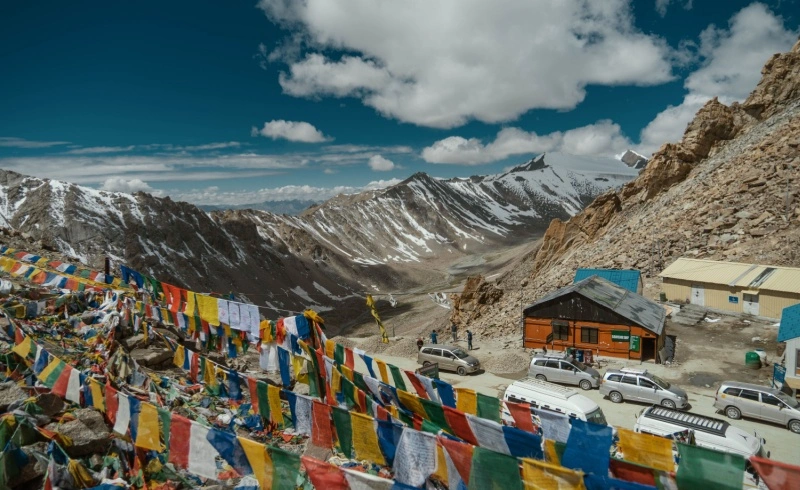
There is a moment, somewhere on the drive from Leh toward Pangong Lake, when the road narrows to a single lane carved into a cliff face, the valley drops away beneath you, and the mountains ahead turn from brown to violet to white, and you realise you have never seen anything like this in your life.
That is Ladakh. And no photograph, however good, quite prepares you for it.
This is a place where Buddhist monks chant in 1,000-year-old monasteries that hang from cliffsides like eagles’ nests. Where a lake sits so high and so still that it mirrors the sky perfectly, and you cannot tell, for a moment, where the water ends and the heavens begin. Where the air is thin and cold and tastes of nothing, and the silence is so complete it has a texture of its own.
For international travellers, Ladakh is increasingly one of the most searched destinations in India. But it is also one that demands more planning than almost anywhere else on the subcontinent. Altitude, permits, seasonal access, and acclimatisation all need to be sorted before you book a single flight.
This guide covers everything you need to know.
Ladakh sits in the northernmost tip of India,a high-altitude cold desert perched between the Himalayas and the Karakoram range, bordered by Tibet to the east and Pakistan to the west. Its capital, Leh, lies at 3,524 metres above sea level. That is higher than most peaks in the Alps.
The landscape here looks nothing like the rest of India. There is no jungle, no humidity, no riot of colour at every turn. Instead, there are vast open valleys the colour of burnt ochre, rivers so glacially cold they run turquoise, mountain passes that touch 5,000 metres, and a sky so intensely blue at altitude that it seems almost artificial.
It is, in the truest sense, another world.
The region divides into two districts: Leh, covering the central and eastern areas, Nubra Valley, Pangong Lake, the Indus Valley and Kargil, covering the western stretches toward Kashmir. For most international visitors, Leh is the base. Everything radiates outward from there.
May to September is the only reliable window, and July–August is the peak. The mountain passes are open, the rivers run full with glacial melt, wildflowers push through the rocky soil in unlikely bursts of yellow and purple, and the light, that extraordinary high-altitude light, turns everything golden by late afternoon.
This is also when Pangong Lake is at its most surreal. The water shifts colour across the day, deep navy at dawn, vivid cobalt by mid-morning, a luminous turquoise by afternoon, as though something beneath the surface is changing its mind about what colour it wants to be.
The Hemis Festival, one of the largest and most visually spectacular Buddhist festivals in the Himalayas, typically falls in late June or early July. Monks perform elaborate masked dances in silk robes and painted wooden masks, drumbeats echoing off stone monastery walls that have stood for a thousand years. If your dates allow it, plan around Hemis.
October is quieter and arguably more beautiful for landscape photography, the valleys turn amber and rust, the crowds thin, and the light softens into something almost melancholy. Temperatures drop sharply after dark. Many camps and higher-altitude routes begin closing by mid-month.
November to April – Ladakh closes. Temperatures plunge to –30°C in January, roads are buried under snow, and most of the region becomes inaccessible. The single exception is the Chadar Trek, a legendary winter expedition across the frozen Zanskar River, where trekkers walk on ice through a canyon so deep and silent it feels prehistoric. Not for the faint-hearted, and not for first-time visitors.
Fly into Delhi’s Indira Gandhi International Airport, then take the first available morning flight to Leh’s Kushok Bakula Rimpochhe Airport, approximately 1 hour 10 minutes in the air, but an hour that will leave you speechless. The flight path cuts directly over the Himalayas. On a clear morning, you will see an unbroken white horizon of peaks stretching in every direction below you, the highest points on earth rendered quiet and small from 10,000 metres. It is one of the great flights in Asian aviation.
Book the earliest morning departure. Mountain weather builds through the day, and afternoon flights to Leh are frequently delayed or cancelled. Morning departures are significantly more reliable.
One critical note: flying directly to Leh means arriving at high altitude with no gradual acclimatisation. Your first day must be a complete rest day. Not a light sightseeing day. A rest day, horizontal, hydrated, doing nothing. More on this below.
Two mountain highways connect Ladakh to the rest of India, and driving either of them is an experience in itself.
The Manali–Leh Highway covers 479 kilometres and crosses five mountain passes, including the famous Rohtang and Tanglang La. It takes two days by road with an overnight halt in a tent camp along the way, typically at Sarchu or Pang. The landscape is staggering, high-altitude plains that look like the surface of Mars, rivers the colour of jade, and passes where you step out of the vehicle into air so thin you feel it immediately in your chest.
The Srinagar–Leh Highway follows the Indus River through dramatic river gorges and the town of Kargil, and is open from May to October. Slightly lower in altitude, it allows a more gradual ascent and is particularly beautiful in the Indus Valley sections where the river runs wide and silver between red cliffs.
Both overland routes do something the flight cannot: they acclimatise you gradually. Your body has two days to adjust as you climb, rather than being delivered to 3,500 metres in a single hour.
Ladakh will humble you. It does not matter how fit you are, how many mountains you have climbed, or how experienced a traveler you consider yourself. Altitude sickness does not discriminate.
At 3,500 meters, the air contains roughly 40% less oxygen than at sea level. Your body notices immediately, even if you do not. Within 12 to 24 hours of arriving in Leh, symptoms can appear: a dull, persistent headache behind the eyes, nausea, fatigue that feels disproportionate to any exertion, and a broken, restless night’s sleep despite exhaustion.
This is Acute Mountain Sickness (AMS), and it affects a significant proportion of visitors who arrive by air.
Rest completely on your first day. Do not visit a single monastery. Do not walk uphill to see the view. Do not have that beer to celebrate your arrival. Drink 3–4 litres of water throughout the day, eat lightly, soups, dal, rice and sleep early.
By day two, most visitors feel significantly better. By day three, the majority feel entirely normal. The people who cut their Ladakh trip short are almost always those who ignored day one.
Speak to your doctor before traveling about Acetazolamide (Diamox), a prescription medication widely used to prevent and treat AMS. Many experienced Ladakh travelers take it as a precaution beginning the day before arrival.
If severe symptoms develop, confusion, inability to walk in a straight line, a cough that produces pink or frothy mucus, descend immediately. This is a medical emergency with no negotiation.
Ladakh requires specific permits for foreign visitors to access most of its signature destinations. Do not let this discourage you, the process is straightforward and any local operator in Leh can arrange it within 24 hours.
Inner Line Permit (ILP) – Required for foreign nationals to visit Nubra Valley, Pangong Lake, Tso Moriri, the Dah-Hanu region, and several other areas. Obtained at the Deputy Commissioner’s Office in Leh or through a registered local tour operator.
Protected Area Permit (PAP) – Required for certain restricted zones near the Chinese border. A registered operator must apply on your behalf.
Carry printed copies of your permits at all times. There are military checkpoints on every road to border-adjacent areas, and they check documents without exception. Your hotel or operator will tell you exactly what you need, budget one morning in Leh to get this sorted before heading anywhere.
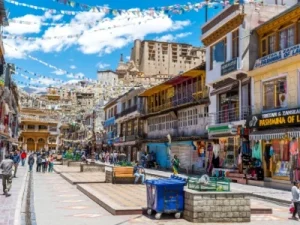
Leh is your base and it rewards time spent in it. The old town, a tangle of whitewashed lanes, prayer flag-strung rooftops, and ancient temples, is best explored slowly, on foot, in the mornings before the heat builds.
Accommodation ranges from family-run guesthouses (some of the warmest hospitality you will encounter anywhere in India) to boutique heritage properties and small luxury hotels with mountain-facing terraces. Homestays with local Ladakhi families are particularly recommended, you eat what the family eats, you learn how butter tea is made, and you understand something about this place that no monastery tour will teach you.
Roughly 120 kilometres north of Leh over Khardung La pass, once listed as one of the highest motorable roads in the world at 5,359 metres, Nubra Valley is a place of startling contrasts. Sand dunes, of all things, rise from the valley floor amid apricot orchards and willow trees, and double-humped Bactrian camels move across them at dusk like something from a Silk Road painting.
Luxury tent camps in Hunder village are the signature stay here. At night, with no light pollution for hundreds of kilometres, the stars are obscene in number.
Staying overnight at Pangong is one of the most otherworldly sleep experiences available anywhere in India. Tent camps line the southern shore at 4,350 metres. At dawn, when the lake is mirror-flat and the mountains behind it are pink and the only sound is the occasional splash of a bar-headed goose landing on the water, you will understand why people come back to Ladakh year after year.
Bring every warm layer you own. The temperature at Pangong drops to near-freezing after sunset regardless of the season.
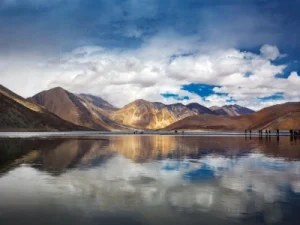
134 kilometres long, sitting at 4,350 metres, divided between India and China, Pangong Tso is one of the highest saltwater lakes in the world and one of the most visually arresting bodies of water on the planet. Its colour is not a fixed thing. It moves through the day, from deep indigo at sunrise to a vivid, almost electric cobalt by mid-morning, softening to aquamarine by afternoon. In photographs it looks enhanced. In person, it looks more enhanced.
The drive from Leh takes approximately five hours through Chang La pass. Every kilometre of it is worth it.
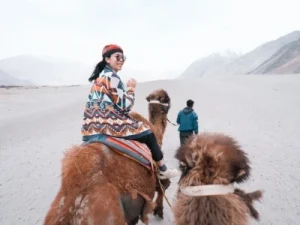
The drive over Khardung La is itself an event, the world falls away on both sides of a road barely wide enough for two vehicles, and at the summit you stand at over 5,000 metres in air so thin that even standing still takes effort. Then the valley opens below you, improbably green after all that grey rock, and the river runs silver through it.
The Bactrian camel safari at Hunder at sunset, shaggy double-humped animals moving slowly across orange sand dunes with the Karakoram rising behind them, is one of those experiences that doesn’t feel entirely real while it’s happening.
Ladakh has over 30 monasteries, and the main circuit around Leh could absorb three days without any sense of repetition.
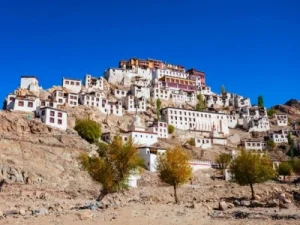
Thiksey Monastery – Rising in tiers from a hilltop like a smaller Potala Palace, Thiksey is best visited at dawn for the morning puja, when monks in crimson robes chant in a hall lit by butter lamps and the smell of juniper incense drifts out into the cold air.
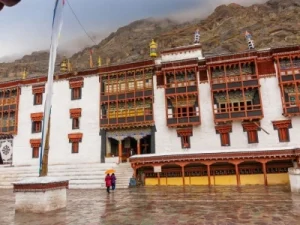
Hemis Monastery – The largest and wealthiest in Ladakh, home to the famous annual festival and to a museum of extraordinarily preserved thangka paintings and sacred objects.
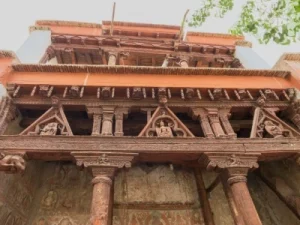
Alchi Monastery – The oldest in Ladakh, dating to the 11th century, with murals that art historians travel from across the world to study. It sits in a small village on the banks of the Indus, looking entirely unassuming from the outside and entirely extraordinary within.
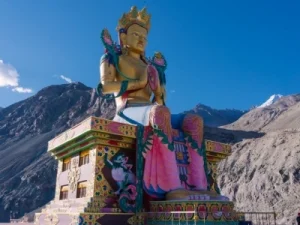
Diskit Monastery – In Nubra Valley, presided over by a 32-metre Maitreya Buddha statue that gazes out across the valley with an expression of profound, unhurried calm.
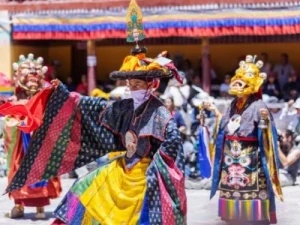
Two days of masked Cham dancing in the courtyard of Hemis Monastery, performed by monks in elaborate silk costumes and carved wooden masks that represent deities, protectors, and demons from the Tibetan Buddhist tradition. Drumbeats that you feel in your chest. Crowds of local Ladakhis in traditional dress sitting on the monastery walls. A sky so blue overhead that it looks painted.
It happens once a year. If your dates align, rearrange your itinerary to be there.
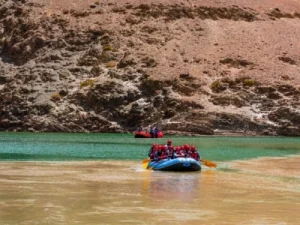
The Zanskar Gorge is one of the most dramatic river canyons in Asia, walls of red and grey rock rising hundreds of meters on either side, the river below running fast and glacially cold and completely clear. White-water rafting through it is available for all levels of experience, from gentle floats to genuine grade-four rapids. Several licensed operators in Leh run full-day and multi-day expeditions.
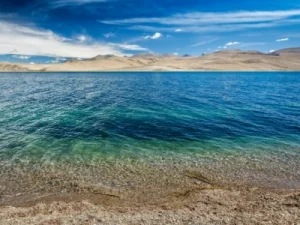
Quieter than Pangong and higher, sitting at 4,522 meters, Tso Moriri is a Ramsar-designated wetland that most visitors never reach. That is their loss. The lake is a shade of blue that has no satisfactory name in English, the surrounding peaks are reflected perfectly in it, and the Changpa nomads who herd their yaks and pashmina goats across the surrounding plateau have been doing so for centuries. It feels like the edge of the inhabitable world, in the best possible way.
6 days – The bare minimum. Acclimatization, monasteries, Pangong. Rushed.
9–10 days – The recommended trip. Acclimatization, full monastery circuit, Nubra Valley overnight, Pangong overnight. Unhurried and complete.
12–14 days – The ideal. Everything above, plus Tso Moriri, Zanskar, and the Markha Valley trek. This is Ladakh properly done.
Sample 9-Day Itinerary:
Carry cash. ATMs exist in Leh town and nowhere else in the region. Nubra, Pangong, Tso Moriri, no ATMs, no card machines, no UPI for foreign cards. Withdraw generously before you leave Leh.
Download offline maps. Mobile data works in Leh and fades to nothing almost everywhere else. Google Maps offline or Maps.me, downloaded the night before you leave, can be the difference between finding a campsite and driving in circles on a mountain road at dusk.
Pack for four seasons. July afternoons in Leh can reach 25°C. July nights in Pangong can touch –2°C. You will need a serious down jacket, thermal layers, and sunscreen SPF 50+ (UV radiation at altitude is severe, burn times are dramatically shorter than at sea level).
Hire a local guide. Not because you cannot navigate without one, you can, but because a good Ladakhi guide will show you things that no guidebook lists, translate the symbolism in monastery murals that would otherwise be opaque, and connect you to the place in a way that independent travel at altitude and pace rarely allows. The cost is modest. The difference to the experience is not.
Respect the monasteries. Remove shoes without being asked. Dress modestly, shoulders and knees covered. Ask before photographing monks, especially during puja. These are living places of worship, not museum exhibits.
Is Ladakh safe for international tourists?
Consistently among the safest regions in India for foreign visitors. The Ladakhi community is welcoming, crime rates are extremely low, and the primary risks are environmental, altitude, cold, and remote terrain, rather than security-related.
Do I need a special visa for Ladakh?
No. A standard Indian tourist visa covers Ladakh. Once there, foreign nationals need the Inner Line Permit for most tourist areas, arranged locally in Leh, not in advance from abroad.
Can I visit Ladakh independently without a tour operator?
Yes, in Leh and on the main circuit. For Nubra, Pangong, and border-area destinations, a registered local operator simplifies the permit process considerably and is worth the cost for a first visit.
Is Ladakh suitable for older travelers?
Age alone is not the determining factor, altitude response is individual and unpredictable. Many travelers in their 60s and 70s visit Ladakh comfortably with proper acclimatization. Anyone with heart conditions, respiratory issues, or high blood pressure should consult a doctor before travel and discuss altitude medication specifically.
What currency is used?
Indian Rupees (INR). Cash only outside Leh town.
Last updated July 2026. Permit requirements and road access are subject to change based on government policy and seasonal weather conditions. Confirm current regulations with your tour operator or the Leh Tourist Office before travel.
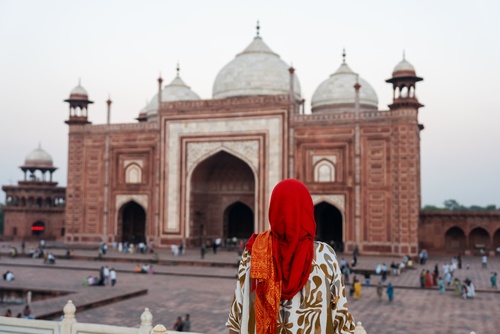
India’s most extraordinary travel experiences are not in its monuments. They are in a weaver’s workshop in Varanasi where a Banarasi silk sari takes three...
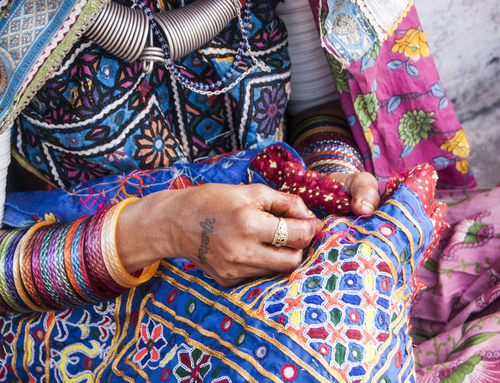
India has more distinct textile and craft traditions than any other country on earth. This is not an approximation. The combination of 28 states, dozens...
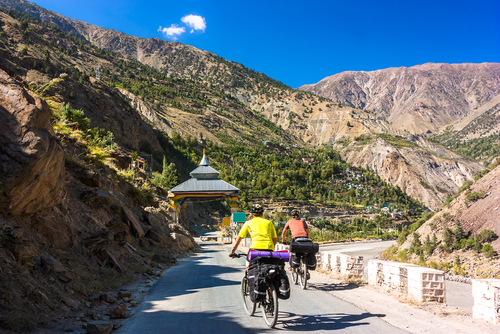
India bookings among adventure travellers surged 214% in the past year. Cycling is at the heart of that surge. International cyclists are discovering that India...
You are one step closer to having the best journey of your lifetime! Talk to us, write to us all that you have envisioned for your India trip, and one of our travel experts will connect with you on priority. To help you explicitly we have WhatsApp and Email addresses!


