


The Colors of India: Understanding What You See as an International Traveller (2026)
The first thing most international visitors notice about India is the color. Not just the quantity of it, though the quantity is overwhelming, but the...


 18884507235

India’s ancient monuments are celebrated for their beauty. What is less often discussed, and what consistently produces the most profound reactions in intellectually motivated international visitors, is their science.
The Iron Pillar of Delhi has stood in the open air for 1,600 years without rusting. Modern metallurgists still cannot fully explain why. The Brihadeeswara Temple’s 66-metre tower casts no shadow outside its own base at any time of day, an engineering achievement requiring geometric calculations of extraordinary precision, accomplished in 1010 CE without modern mathematics or computer modelling. The Jantar Mantar observatories of Jaipur, Delhi, and three other cities, built in the 18th century, contain astronomical instruments accurate to within two seconds per day.
These are not ancient curiosities. They are genuine scientific achievements. And standing inside them, understanding what was accomplished here, by whom, with what knowledge, and how long ago, produces a quality of intellectual wonder that the merely beautiful cannot generate.
This guide covers India’s most extraordinary scientific and engineering heritage for international visitors.
In the courtyard of the Qutb Minar complex in south Delhi stands a 7-metre iron pillar that has been in the open air, exposed to rain, heat, humidity, and the full range of Delhi’s climate, for approximately 1,600 years. It shows no significant rusting.
The pillar was cast in the 4th or 5th century CE during the Gupta period, a golden age of Indian mathematics, astronomy, and metallurgy. Its iron is of extraordinary purity, approximately 98% pure, with a specific composition of phosphorus and other trace elements that creates a passive protective layer on the surface that prevents oxidation.
What makes it scientifically remarkable: The ability to produce iron of this purity and in this quantity, the pillar weighs approximately 6 tonnes, was not achieved again anywhere in the world until the 19th century, when industrial steel production made high-purity iron relatively straightforward. The Gupta-period metallurgists who produced it did so using charcoal forges and techniques that modern materials scientists, even with full knowledge of the pillar’s composition, have not been able to exactly replicate.
The pillar bears a Sanskrit inscription that records its original erection as a flagstaff in honour of the god Vishnu. It was later moved to its current location, possibly by Anangpal Tomar, founder of Delhi, in the 10th century. It has been standing in different locations in the Delhi region for over 1,600 years.
Visiting: The Iron Pillar is inside the Qutb Minar complex, one of India’s most significant archaeological sites and a UNESCO World Heritage Site. Allow a full morning. The pillar is accessible as part of the complex visit and is best seen early in the morning when the low light illuminates its surface.
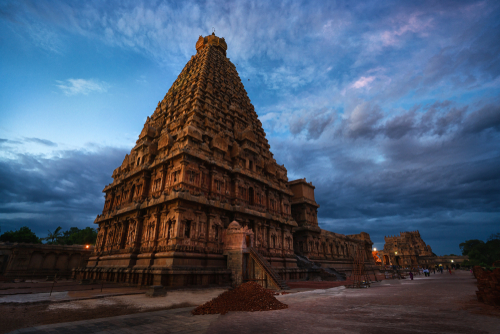
The Brihadeeswara Temple in Thanjavur, Tamil Nadu, built in 1010 CE by the Chola king Rajaraja I, contains an engineering mystery that has been studied by architects and structural engineers for over a century without a fully satisfying explanation.
The central vimana tower rises 66 metres from the ground. It was built from interlocking granite blocks assembled without mortar, each block cut to precise dimensions and fitted to its neighbours through gravity and geometric precision alone. At any time of day, regardless of the position of the sun, the shadow of the tower falls entirely within the footprint of its own base. It never extends outward onto the surrounding courtyard.
This is geometrically extraordinary. A tower of this height should cast a long shadow at low sun angles, early morning and late afternoon. The fact that it does not means the taper of the tower was calculated with sufficient precision to contain the shadow at all sun angles achievable at Thanjavur’s specific latitude. The Chola architects who designed it accomplished this without calculus, without computer modelling, and without the ability to test the design at full scale before committing 130,000 tonnes of granite to the project.
The capstone: The granite capstone at the top of the tower, a single stone estimated to weigh 80 tonnes, was raised to a height of 66 metres during construction using a ramp system whose length, based on the gradient required to move a stone of this weight, would have extended approximately 6 kilometres from the temple. No physical evidence of this ramp survives. Its existence is inferred entirely from the engineering logic of the problem.
Visiting: Thanjavur is 350 kilometres from Chennai by road, or accessible by train. The temple is an active place of worship, morning and evening rituals are performed daily. The best time to observe the shadow phenomenon is between 11am and 1pm when the sun is at its highest and the shadow should, by normal geometric logic, be at its longest.
Between 1724 and 1735, the Maharaja of Jaipur, Sawai Jai Singh II, built five astronomical observatories at Jaipur, Delhi, Varanasi, Ujjain, and Mathura. He called them Jantar Mantar, from the Sanskrit yantra mantra, meaning instrument of calculation.
The observatories contain monumental masonry instruments, sundials, gnomon structures, celestial coordinate instruments, built at enormous scale specifically to improve measurement accuracy. The largest instrument, the Samrat Yantra at Jaipur (a massive sundial whose gnomon rises 27 metres), can measure time to within two seconds per day, an accuracy that rivals modern precision instruments.
What makes them remarkable: Jai Singh built these observatories not as architectural statements but as working scientific tools, motivated by his frustration with the inaccuracies he found in the astronomical tables then in use across the Islamic and European worlds. He corresponded with the Portuguese Viceroy in Goa and with European astronomers. He studied Islamic, Hindu, and European astronomical traditions simultaneously. And he built instruments at monumental scale, understanding that larger instruments produce more precise measurements that remain functional and accurate today.
The Jaipur Jantar Mantar, a UNESCO World Heritage Site, is the largest and finest of the five observatories. It contains 19 astronomical instruments covering every significant measurement of celestial position, time, and solar angle. A knowledgeable guide can demonstrate the functioning of each instrument with a clarity that transforms what appears to be a collection of unusual masonry structures into a sophisticated scientific complex of extraordinary ambition.
Visiting: The Jaipur Jantar Mantar is in the old city, walking distance from the City Palace. Allow 1.5–2 hours with a specialist guide. The instruments are best demonstrated at specific times of day, ask your guide to explain which instruments work best at which hours.
The Kailasa Temple at Ellora, Cave 16 in the Ellora cave complex of Maharashtra, is the largest monolithic structure carved from rock in the world. Unlike the other caves at Ellora, which were excavated inward into the cliff face, the Kailasa Temple was carved downward from the top of a basalt plateau, the surrounding rock removed to create a freestanding temple within a courtyard, the entire structure remaining connected to the bedrock below it.
The numbers are staggering. The temple is 164 feet wide, 276 feet deep, and 100 feet high. The Archaeological Survey of India estimates that approximately 200,000 tonnes of rock were removed during its construction, a project that took approximately 100 years to complete, beginning in the 8th century CE under the Rashtrakuta dynasty.
The engineering problem: The Kailasa Temple was carved top to bottom, the builders began at the top of the plateau and worked their way down, carving the roof first, then the walls, then the foundations. This means that every structural decision was final, there was no possibility of revision, no ability to correct a miscalculation, no way to add support after the fact. The entire three-dimensional design, every column, every doorway, every decorative panel, had to be understood completely before the first chisel struck the rock.
What confounds modern engineers: The scale of the planning required to execute the Kailasa Temple, to visualise the entire complex in three dimensions before beginning, to coordinate the removal of 200,000 tonnes of rock in a precise sequence without structural collapse, represents a level of architectural and engineering cognition that modern architects, confronted with the finished structure, consistently describe as difficult to comprehend even with all the advantages of modern mathematics and structural theory.
Visiting: Ellora is 30 kilometres from Aurangabad in Maharashtra. The cave complex is a UNESCO World Heritage Site. The Kailasa Temple (Cave 16) is the centrepiece, allowing a full half-day for the temple alone. Visit in the morning when the light enters the courtyard from the east.
The Indus Valley city of Dholavira, built approximately 4,500 years ago on a small island in the Rann of Kutch in Gujarat, solved the problem of water supply in a desert environment with a hydraulic engineering system that was not surpassed in sophistication anywhere in the ancient world.
The city sits between two seasonal rivers that flow only during and immediately after the monsoon. For the remaining nine months of the year, the Rann of Kutch is dry. The Dholavirans solved this through a system of 16 reservoirs, some cut from bedrock, some constructed from stone, connected by channels and sluices that captured monsoon floodwater and stored it through the dry season.
The scale of achievement: The largest reservoir at Dholavira is 79 metres long, 12 metres wide, and 7 metres deep, with steps descending on all four sides. The entire reservoir system, designed, built, and maintained 4,500 years ago, held sufficient water for a population of 20,000 people through nine months of zero rainfall in a desert environment. The engineering precision required to design channels, gradients, and storage capacity for this system at this scale, with the knowledge available in the Bronze Age, is an achievement that water engineers who study it consistently describe with genuine admiration.
Visiting: Dholavira is in the Rann of Kutch in Gujarat, 250 kilometres from Bhuj, accessible by private vehicle. A UNESCO World Heritage Site since 2021. Read the full Dholavira guide on this site for complete planning information.
The Sun Temple at Konark in Odisha, built in the 13th century CE by King Narasimhadeva I of the Eastern Ganga dynasty, was designed as a colossal stone chariot of the sun god Surya. Its 24 intricately carved stone wheels and seven straining horses were not decorative elements. They were a functional solar calendar.
The astronomical engineering: The 24 wheels of the Konark Sun Temple are sundials. Each wheel has 8 major spokes and 8 minor spokes, dividing the day into 8 praharas (3-hour periods) and 24 hours respectively. The shadow cast by the spokes moves at a measurable rate that allows time to be read to within minutes of accuracy. The temple’s orientation, precisely aligned to the cardinal directions, ensured that the rising sun would illuminate the main deity on specific significant dates.
The construction achievement: The main shikhara tower of the Konark Sun Temple, which collapsed centuries ago, was estimated at approximately 70 metres in height, built from chlorite schist and laterite using an iron beam reinforcement system that was not standard in Indian temple construction of the period. The beam, called the Dandasana, was a piece of iron approximately 10 metres long and estimated to weigh several tonnes, used to anchor the tower’s central core. How it was positioned remains a subject of architectural study.
Visiting: Konark is 65 kilometres from Bhubaneswar in Odisha. The UNESCO-listed Sun Temple and the adjacent Chandrabhaga Beach can be combined in a single day trip from Bhubaneswar or Puri.
These sites are distributed across India but cluster naturally into regional circuits.
Delhi circuit: Iron Pillar (Qutb Minar complex), Jantar Mantar Delhi. Half a day covers both.
Jaipur circuit: Jantar Mantar Jaipur (the largest and finest). Combined with the City Palace and Amber Fort for a full heritage day.
Maharashtra circuit: Kailasa Temple at Ellora, combined with the Ajanta cave paintings. Base in Aurangabad for 3 days.
Tamil Nadu circuit: Brihadeeswara Temple at Thanjavur, combined with the Chola bronze collections and the Meenakshi Temple at Madurai.
Gujarat circuit: Dholavira, combined with Rani Ki Vav, step well at Patan and the Rann of Kutch. Base in Bhuj for 3 days.
Odisha circuit: Konark Sun Temple, combined with the Jagannath Temple at Puri and the tribal regions of Odisha’s interior.
Which is the most accessible of India’s scientific wonders for international tourists?
The Iron Pillar at the Qutb Minar complex in Delhi is the most accessible, it is in a major city, well connected, and part of one of Delhi’s most significant archaeological sites. The Jantar Mantar in Jaipur is equally accessible and more interactive, the instruments can be demonstrated in real time by a knowledgeable guide.
Do I need a specialist guide to appreciate these sites?
For the Jantar Mantar, a specialist guide is essential, the instruments look like abstract masonry without explanation and become extraordinary scientific tools with it. For the Iron Pillar and the Kailasa Temple, a good general guide with knowledge of the specific site provides sufficient context. For the Brihadeeswara Temple’s shadow phenomenon, a guide who knows exactly when and where to observe it is helpful.
Can these sites be combined with standard India sightseeing?
Yes, and this combination produces the most complete India itinerary available. The Qutb Minar complex and Delhi’s Jantar Mantar are standard Delhi inclusions. The Jaipur Jantar Mantar is adjacent to the City Palace. Ellora combines with Ajanta. Konark combines with Puri and Bhubaneswar. None of these require separate dedicated trips.
India’s scientific heritage is as extraordinary as its cultural heritage, and experiencing it properly requires the knowledge and specialist guidance that transforms ancient masonry into genuine intellectual revelation. At GeTS Holidays, we build India itineraries for premium international travellers that engage with every dimension of what makes this country extraordinary, including the scientific achievements that modern engineers still study with admiration. Begin at [www.getsholidays.com].

The first thing most international visitors notice about India is the color. Not just the quantity of it, though the quantity is overwhelming, but the...
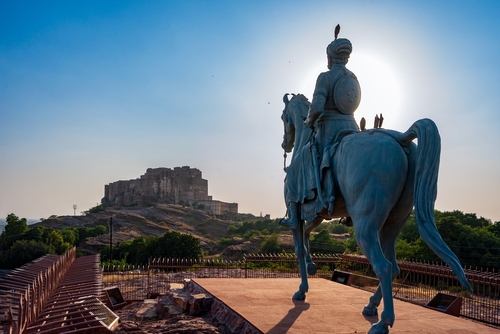
Most international tourists who visit Rajasthan’s palace hotels do not realise something extraordinary: the families who built those palaces are still here. India’s 565 royal...
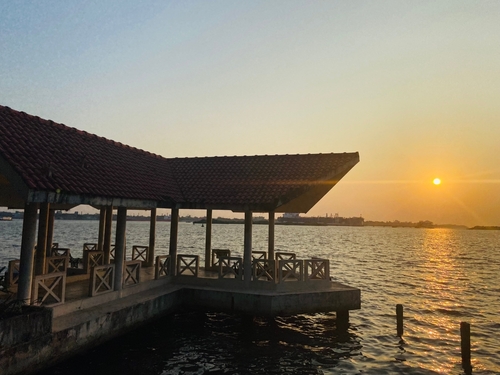
Kochi is India’s most trending international destination in 2026. This is not a marketing claim, it is the finding of travel search data across European...
You are one step closer to having the best journey of your lifetime! Talk to us, write to us all that you have envisioned for your India trip, and one of our travel experts will connect with you on priority. To help you explicitly we have WhatsApp and Email addresses!


