


Experiential Travel in India: Beyond Sightseeing for International Tourists (2026)
India’s most extraordinary travel experiences are not in its monuments. They are in a weaver’s workshop in Varanasi where a Banarasi silk sari takes three...


 18884507235

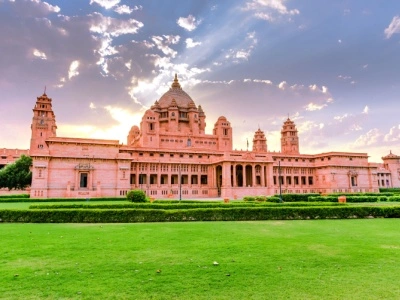
The first time you drive through the gates of a Rajasthan palace hotel, something shifts. The noise of the road disappears. A uniformed attendant materialises from the shadows to open your car door. And standing before you, glowing amber in the late afternoon sun, is a building that was receiving maharajas and their courts centuries before the concept of a hotel existed anywhere in the world.
This is not a themed resort. This is not a building designed to look like a palace. This is the actual palace. The same marble floors that royal feet once crossed. The same carved sandstone jharokhas, those ornate projecting balconies, from which queens once watched elephant processions move through the courtyards below. The same astronomical precision in the placement of every window, so that at certain times of year the light falls exactly where it was intended to fall, painting a strip of gold across a floor of inlaid stone.
Rajasthan’s heritage hotels are among the most distinctive accommodation experiences available anywhere on earth. But they are also widely misunderstood, by travellers who assume they are prohibitively expensive, by those who book the wrong one for their expectations, and by those who arrive without quite understanding what they are sleeping inside.
This guide covers all of it.
In the years following Indian Independence, Rajasthan’s royal families faced an uncomfortable reality. Their ancestral palaces, forts, hunting lodges, and havelis, vast, ornate, and extraordinarily expensive to maintain, were becoming financially unsustainable. The privy purses that had supported royal households since 1947 were abolished in 1971. The properties needed a new purpose or they would simply fall apart.
The solution, pioneered by a handful of visionary royal families and later formalised through the Heritage Hotels Association of India, was conversion. Palaces became hotels. Hunting lodges became boutique retreats. Havelis, the grand merchant mansions of Rajasthan’s prosperous trading families, became intimate guesthouses where travellers could sleep in rooms still carrying the original frescoes on their walls and the original carved stone screens on their windows.
What made this different from ordinary hotel conversion was the intent: not to erase the history of a building but to make it liveable, accessible, and sustainable, to give the past a reason to be maintained.
Today Rajasthan has over 100 classified heritage properties, ranging from grand palace hotels with swimming pools, multiple restaurants, and spa facilities, to small family-run havelis with six rooms and a rooftop where the owner’s grandfather will join you for evening chai and spend an hour telling you stories about the building you are sitting in.
The Rajasthan government classifies heritage hotels into three official categories:
Heritage Classic – Properties between 50 and 100 years old, maintaining original architectural character throughout.
Heritage Grand – Properties over 100 years old with significant historical and architectural value.
Heritage Legacy -The highest classification, reserved for properties of exceptional historical importance: former royal residences, garrisoned forts, and palaces directly associated with Rajasthan’s ruling dynasties.
This is the question every traveller asks, and the honest answer is: it depends entirely on which property you choose and what you are expecting from it.
The price range is enormous. A family-run haveli in a smaller town like Bundi or Shekhawati might cost ₹4,000–7,000 per night ($50–85 USD) and deliver an experience of extraordinary intimacy, home-cooked Rajasthani food, a family member who walks you through every room’s history unprompted, and a level of personal attention that no large hotel can replicate. At the other end of the spectrum, the Taj Lake Palace in Udaipur or Umaid Bhawan in Jodhpur can reach $800–1,500 USD per night for their signature suites.
What justifies the cost at the upper end is not thread count or bathroom size. It is the irreplaceable nature of the experience itself, the fact that you are sleeping in a room where history happened, in a building that the finest craftsmen of its era spent decades constructing by hand, in a landscape that has barely changed in centuries.
The properties that consistently disappoint are those that have prioritised renovation over authenticity, stripping out original features in favour of generic luxury finishes that could belong to any five-star hotel anywhere in the world. The properties that consistently exceed every expectation are those where the original character has been preserved with care, where the history is worn proudly rather than tucked away, and where the people running the place genuinely love the building they are managing.
How to tell the difference before booking is covered below.
Udaipur is, by widespread agreement, the most beautiful city in Rajasthan. Built around a series of artificial lakes and anchored by the vast City Palace complex that rises in tiers from the eastern shore of Lake Pichola, it is a city that appears to have been designed specifically to be reflected in water, and in the late afternoon, when the light turns the palace walls copper and the lake goes completely still, it very nearly breaks your heart.
Taj Lake Palace – Built in 1746 as a summer pleasure palace for Maharana Jagat Singh II, the Lake Palace occupies an entire island in the middle of Lake Pichola and is accessible only by boat. There is no road to it. You arrive by water, greeted at a small marble jetty by attendants in white, and the world you left behind on the shore immediately feels very far away. The 65 rooms and suites look out over the lake from every direction. At night, with the City Palace illuminated on the far shore and the water perfectly black and still beneath you, it is simply one of the most extraordinary hotels in the world.
Taj Fateh Prakash Palace – Part of the City Palace complex itself, sharing its walls and inner courtyards with the royal family’s museum and residence. Staying here means waking up inside Udaipur’s most iconic building, with lake views from rooms that once served the royal household directly. The Crystal Gallery, a collection of extraordinarily ornate furniture commissioned in carved crystal from England in the 1870s, never used during the maharaja’s lifetime, is accessible to hotel guests.
Raas Devigarh – Twenty-eight kilometres outside Udaipur, this 18th-century hilltop fort has been converted into one of Rajasthan’s most design-forward heritage properties. The interiors are all white marble and spare contemporary lines, a deliberate contrast to the ancient fort walls that contain them. For travellers who want genuine heritage architecture with a contemporary aesthetic sensibility rather than period-style décor, Devigarh is perhaps the finest example in the entire state.
Jaipur’s heritage hotel landscape is built around properties that once served the Jaipur royal family and the vast court that surrounded them, ambassadors, nobles, merchants, and the retinues that accompanied them all.
Samode Palace – Forty-two kilometres from Jaipur in the village of Samode, this 475-year-old palace is one of the best-preserved and most consistently celebrated heritage hotels in Rajasthan. The Sheesh Mahal; the Hall of Mirrors, is a room of such extraordinary craftsmanship that guests who have stayed at palace hotels across India and the world regularly cite it as the single most visually arresting interior they have encountered. The property has been owned and operated by the same family for generations, and it shows, in the quality of attention, in the depth of knowledge that every staff member brings to interaction, and in the sense that the building is genuinely loved rather than merely managed.
Rambagh Palace – Once the official residence of the Maharaja of Jaipur, Rambagh was converted in 1957 and is now managed by the Taj Hotels group. It represents the grandest expression of Jaipur’s palace hotel tradition, 47 acres of Mughal gardens, a polo ground, a ballroom that has hosted royalty and heads of state, and suites where the Maharaja himself once slept, now available to guests for a night that is genuinely unlike any other.
Alsisar Haveli – For travellers who want Jaipur’s heritage experience at a more human scale and price point, this 125-year-old merchant mansion in the old city delivers original frescoes, carved sandstone courtyards, and a rooftop restaurant that looks out over the Pink City’s rooftops at the exact hour the light turns everything rose-gold. One of the best value heritage stays in Rajasthan.
Jodhpur is anchored by what is arguably the most dramatic heritage hotel setting in all of India, a city that tumbles down a hillside in a wash of indigo-painted houses toward a vast, sun-scorched plain, presided over from above by a fort of such scale and gravity that it seems less built than grown from the rock it stands on.
Umaid Bhawan Palace – Construction began in 1929 on the orders of Maharaja Umaid Singh as a public works project to provide employment during a devastating famine, and took 15 years and 3,000 artisans to complete. The result is one of the largest private residences ever built , a 347-room Art Deco sandstone palace of extraordinary proportion and craftsmanship. A section is managed by Taj Hotels, a section houses the royal family’s private residence, and a section operates as a museum. The indoor swimming pool, a golden, mosaic-lined Art Deco chamber that looks as though it was designed for a scene from a 1930s film, is among the most beautiful hotel amenities in Asia.
RAAS Jodhpur – A 2011 conversion of a cluster of historic havelis within the old city walls, positioned at the base of Mehrangarh Fort. The rooms look directly up at the fort’s ramparts from private terraces, an entirely unobstructed view of one of India’s greatest monuments from your own outdoor space. The design is contemporary and deliberately minimal, letting the fort do all the visual work. It consistently appears on best-hotel lists not because of what has been added to it, but because of what has been left alone.
Suryagarh – Built on the road between Jaisalmer town and the Thar Desert dunes, Suryagarh occupies a fascinating middle category. It is not a converted heritage property but was constructed using traditional Rajput fort architecture, locally quarried golden sandstone, and craft techniques, stone carving, mirror inlay, fresco painting, that were brought in from workshops that have been practising them for generations. The desert-facing terraces at sunset, when the sky turns violet and the sand below catches the last light, produce one of Jaisalmer’s finest views.
Fort-based guesthouses – The fort at Jaisalmer is a UNESCO-listed living settlement, one of the very few remaining in the world where people still actually live, work, and worship within the walls of a medieval citadel. Several small hotels and guesthouses operate inside it. Staying here means sleeping inside a 12th-century sandstone fort with the desert stretching away below you in every direction. One responsibility note: there are documented concerns about water usage from hotels within the fort walls damaging the ancient foundations. If you choose to stay inside, select an operator with a demonstrated commitment to responsible water management.
Bundi – One of Rajasthan’s most undervisited and most rewarding towns. The palace and fort that rise above Bundi’s narrow lanes are as dramatic as anything in Jaipur; layered, painted, full of hanging gardens that have gone beautifully wild, but the town below them sees a fraction of the visitors. Several small heritage guesthouses offer rooftop views of the palace for rates that seem almost implausible given the quality of the vista.
The Shekhawati Region – A cluster of towns in northern Rajasthan, Mandawa, Nawalgarh, Fatehpur, whose 18th and 19th-century merchant families competed ferociously to commission the most elaborately frescoed havelis in the region. The results constitute one of the world’s great open-air art collections: entire facades and ceilings covered in painted scenes of mythology, wildlife, court life, and; as the artists encountered modernity, trains, aeroplanes, and telephones alongside gods and elephants. Several of these havelis now operate as heritage hotels. Sleeping inside a room whose every surface is painted with two-century-old murals is an experience available almost nowhere else on earth.
No two rooms in a genuine heritage property are identical, and this is both the most appealing and the most important thing to understand before booking. Original rooms were built for royalty whose priorities bore little resemblance to the checklist of modern luxury travel. Ceilings are often very high, which creates cool rooms in summer and cold ones in winter. Bathrooms were added into spaces not originally designed for them, which means some are generous and some are creatively compact. Some rooms will have views that stop you mid-sentence. Others in the same property will look onto interior service courtyards.
Always ask specifically about the room before booking. Request lake-facing, fort-facing, or courtyard-facing depending on the property. Ask whether the room retains original features or has been renovated. Ask which floor. A five-minute conversation with the reservations team before you confirm can make an enormous difference to what you wake up to.
Rajasthani cuisine is one of India’s most distinctive regional cooking traditions — evolved over centuries in a desert environment where fresh vegetables were scarce and the governing principles were richness, preservation, and depth. Heritage hotels at the better end take their kitchens seriously, building menus around dishes that royal households once ate and that carry the flavours of this specific landscape.
Dal Baati Churma — round wheat dumplings baked hard in a wood fire, served with a rich, smoky lentil curry and accompanied by churma, a crumbled sweet of coarse wheat flour, clarified butter, and sugar. It is one of those combinations that makes no obvious sense on paper and complete sense on the plate.
Laal Maas — a slow-cooked mutton curry of serious heat, traditionally made with Mathania red chillies grown in a village outside Jodhpur. The colour is a deep, dark crimson. The flavour is complex and layered in a way that slow heat over hours produces and nothing else can replicate.
Ker Sangri — a preparation of dried desert beans and berries that has sustained Rajasthani communities through droughts for generations. It tastes unlike anything else in Indian cuisine — a little sour, a little smoky, uniquely itself.
The finest heritage hotel dining experiences go further: meals served in a torchlit fort courtyard with folk musicians performing in one corner, or breakfast on a lake-facing terrace as the morning mist lifts off the water and the egrets pick their way along the far shore.
At the best heritage properties, service carries a character that distinguishes it entirely from standard luxury hospitality. Staff at family-run properties often possess a knowledge of the building, the family’s history, and the surrounding area that no training programme can produce, because it has been absorbed over years and decades of living alongside the place rather than learned from a manual in a week.
This is where smaller, family-run heritage properties frequently outperform their grander counterparts. A ten-room haveli where the owner joins guests for dinner and can tell you which craftsman carved the central jharokha, and in which decade, and what the family was doing at that time in Rajasthan’s history, that is a different experience from a hundred-room palace where the service is polished and entirely impersonal.
A three-star heritage hotel with original frescoes on the ceiling, a family still involved in daily operations, and a rooftop where you can watch the sun go down over a fort that has stood for 500 years will almost always deliver a more lasting memory than a five-star property that has renovated away every trace of what made it interesting.
Look for: original architectural features described explicitly and specifically in guest reviews. Family involvement in day-to-day management. The age and official classification of the property. Guest feedback that talks about the history and character of the building rather than exclusively about the pool and the wifi.
Udaipur demands a lake view, the relationship between the city’s buildings and its water is the entire point, and a room that cannot see the lake misses the essential experience. Jodhpur demands a fort view, waking up to Mehrangarh from your terrace is one of the great hotel views in India and nothing else in the city compares. Jaisalmer demands proximity to the fort and the desert. Jaipur is the most flexible of all, the city’s heritage is distributed across its entire fabric rather than concentrated in a single landmark.
A 100-room palace hotel and a 10-room haveli are entirely different experiences. Grand palace hotels offer facilities, multiple restaurants, spas, pools, cultural performances, that boutique properties cannot. Boutique properties offer intimacy, personal attention, and the kind of access to the building’s history and family stories that grand hotels cannot. Neither is superior. They serve different travellers with different priorities.
Book directly with the property where possible. Most smaller heritage hotels offer better rates for direct bookings and are significantly more responsive to specific room requests, early check-in arrangements, and special experiences. For Taj and Oberoi-managed properties, their own websites and loyalty programmes consistently offer better value than third-party platforms.
Ask about experiences before you arrive. The best heritage hotels offer things that are never prominently advertised: guided walks through sections of the property not open to general guests, cooking classes in the palace kitchen, visits to family-owned craft workshops, private folk music evenings in the courtyard. A single email before arrival is usually all it takes.
Visit even if you are not staying. Many of Rajasthan’s most celebrated palace hotels, the Lake Palace, Rambagh, Umaid Bhawan, welcome non-guests for lunch, afternoon tea, or dinner. For travellers who want the experience of these extraordinary spaces without the room rate, a meal or even just tea in the courtyard is entirely worth arranging.
Consider the shoulder season. Peak season (November–February) sees Rajasthan’s heritage hotels at their most expensive and their most atmospheric. But October and March offer the same properties at 30–50% lower rates with smaller crowds and equally beautiful light. September, at the tail end of the monsoon, brings an unexpected lushness to Rajasthan’s landscape that most visitors never see.
Are heritage hotels in Rajasthan suitable for families with children?
Many are, though it varies significantly by property. The larger palace hotels, Rambagh, Umaid Bhawan, Samode, have family facilities and children’s programmes. Smaller havelis with precious original features, open courtyards, and steep stone staircases are generally better suited to couples and adult travellers.
What is the difference between a palace hotel and a haveli hotel?
A palace hotel was originally a royal residence, built for and inhabited by a maharaja or a member of the ruling dynasty. A haveli was the grand residence of a wealthy merchant, noble, or court official, typically smaller and often more elaborately decorated with painted frescoes and carved stone screens. Both offer authentic heritage experiences; the scale, grandeur, and character differ substantially.
How far in advance should I book?
For peak season (November–February), the most sought-after properties, Taj Lake Palace, Samode Palace, Umaid Bhawan, should be booked 3–6 months in advance. Shoulder season (September–October and March) typically requires 4–8 weeks. Off-season availability is often excellent even with short notice, and rates reflect it.
Can I visit a heritage hotel without staying there?
Yes, and it is worth doing. Most of Rajasthan’s famous palace hotels welcome non-guests for dining. Book in advance, these restaurants are consistently busy during peak season and the experience of lunch in the Lake Palace courtyard or tea in Rambagh’s gardens is entirely memorable even without a room key in your pocket.
Is the water safe to drink in heritage hotels?
All reputable heritage properties provide bottled or filtered water for drinking. Do not drink tap water anywhere in Rajasthan regardless of the property’s classification or price point.
Last updated July 2026. Room rates and heritage classifications are subject to change. Always confirm directly with properties before booking. Heritage hotel categories are officially classified by the Rajasthan Tourism Development Corporation.
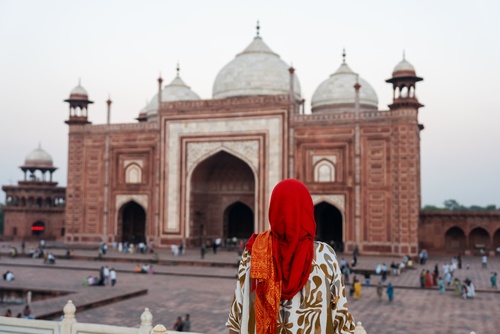
India’s most extraordinary travel experiences are not in its monuments. They are in a weaver’s workshop in Varanasi where a Banarasi silk sari takes three...

India has more distinct textile and craft traditions than any other country on earth. This is not an approximation. The combination of 28 states, dozens...
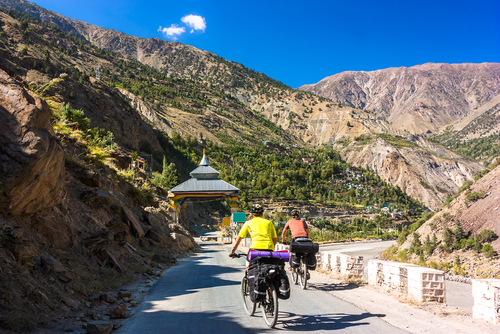
India bookings among adventure travellers surged 214% in the past year. Cycling is at the heart of that surge. International cyclists are discovering that India...
You are one step closer to having the best journey of your lifetime! Talk to us, write to us all that you have envisioned for your India trip, and one of our travel experts will connect with you on priority. To help you explicitly we have WhatsApp and Email addresses!


