October 12, 2026
Not all travel is about beauty. Some of the most powerful journeys are about bearing witness.
Dark tourism; travel to sites associated with death, tragedy, suffering, and historical atrocity, has become one of the fastest-growing travel segments globally in the 21st century. It is not morbid curiosity. At its best, it is an act of historical responsibility, a commitment to understanding what happened in specific places so that the past is not forgotten and its lessons are not lost.
India has some of the most significant dark tourism sites in Asia. The legacy of colonial rule. The trauma of Partition. The violence of massacre and imprisonment. The ongoing reckoning with the consequences of industrial disaster. These sites are not comfortable to visit. They are among the most important.
This guide covers the most significant dark tourism destinations in India for international visitors in 2026.
What Dark Tourism Is, and What It Is Not
Dark tourism is not about seeking entertainment from tragedy. It is about engaging honestly with history, including its most difficult chapters.
The finest dark tourism experiences produce empathy rather than voyeurism, historical understanding rather than spectacle, and a quality of reflection that comfortable sightseeing rarely generates.
India’s dark tourism sites are particularly significant for international visitors because many involve histories in which the visitor’s own country may have played a direct role, colonial atrocities, imperial exploitation, and the human cost of political decisions made in London, Washington, and Delhi that are still felt today.
Visiting these sites with genuine attention is not just tourism. It is education. And it is respect.
Cellular Jail, Port Blair – Andaman Islands
The Cellular Jail is India’s most internationally significant dark tourism site and one of the most powerful colonial-era monuments in Asia.
Built by the British between 1896 and 1906 on the Andaman Islands, then a remote colonial penal settlement, the Cellular Jail was designed specifically to isolate political prisoners from the Indian independence movement. Its radial design, with seven wings extending from a central watchtower, ensured that no prisoner could see another. Solitary confinement was the norm. The conditions were deliberately brutal.
The prisoners who were sent here, called Kala Pani (Black Water) because crossing the ocean was considered a ritual pollution in Hindu tradition, included some of the most significant figures of India’s independence struggle. Veer Savarkar spent years here. Batukeshwar Dutt, who bombed the Central Legislative Assembly with Bhagat Singh, was imprisoned here.
What to see: The preserved prison wings with original cells, each 4.5 metres by 2.7 metres, designed for one person, holding three or four by the end. The gallows where prisoners were executed. The torture room. The museum documents the independence movement activists who were imprisoned here.
The Sound and Light Show: Every evening, a sound and light show recounts the stories of the prisoners through narration and illumination. It is theatrical in approach and deeply moving in effect. Do not skip it.
Why it matters for international visitors: The Cellular Jail is a direct product of British imperial policy, built specifically to remove Indian political prisoners from the mainland and eliminate them from the independence movement. Visiting it as a British citizen, in particular, produces a quality of historical reckoning that is uncomfortable and entirely necessary.
Getting there: Fly to Port Blair from Chennai, Kolkata, or Delhi. The jail is in Port Blair town, a 10-minute drive from the main accommodation area.
Jallianwala Bagh, Amritsar – Punjab
On 13 April 1919, British Indian Army troops under the command of Brigadier General Reginald Dyer opened fire on a crowd of unarmed civilians gathered in the walled garden of Jallianwala Bagh in Amritsar. The firing continued for approximately 10 minutes. Official British figures recorded 379 deaths. Indian National Congress estimates placed the death toll at over 1,000.
The massacre was a turning point in India’s independence movement. It radicalised Gandhi, who had until that point been advocating cooperation with the British administration. It horrified the world. And it produced one of the most significant acts of historical accountability in British parliamentary history, though Dyer was never criminally prosecuted.
What to see: The walled garden itself, the walls are still standing, still containing the narrow entrances that prevented the crowd from escaping the firing. The bullet marks on the walls, preserved deliberately, visible to this day. The well into which hundreds of people jumped to escape the bullets and drowned. The eternal flame memorial.
Why it is significant: Jallianwala Bagh produces a specific quality of stillness in visitors that few historical sites achieve. Standing in the garden, understanding the geometry of what happened, seeing the bullet marks, reading the names on the memorial, produces a visceral historical comprehension that no amount of reading can replicate.
Combining with the Golden Temple: Jallianwala Bagh is 200 metres from the Golden Temple. The contrast, the most sacred site in Sikhism expressing the tradition of seva (selfless service) and the Langar’s daily feeding of 100,000 people, adjacent to a site of colonial massacre, is one of the most historically and emotionally layered juxtapositions available to a visitor anywhere in India.
Getting there: Amritsar is accessible by direct flight from Delhi (1 hour) or by overnight train. The Jallianwala Bagh memorial is in the old city, walking distance from the Golden Temple.
The Partition Museum, Amritsar – Punjab
The Partition of British India in August 1947, the division of the subcontinent into the independent nations of India and Pakistan, produced one of the largest forced migrations in human history. Between 10 and 20 million people were displaced. Between 200,000 and 2 million were killed in communal violence. Entire communities that had coexisted for generations were torn apart along religious lines in a matter of weeks.
The Partition Museum in Amritsar, opened in 2017 and the first museum in the world dedicated entirely to the Partition experience, documents this history through survivor testimonies, archival materials, personal objects, and immersive installations of considerable emotional power.
What to see: The testimonies, recorded video accounts from Partition survivors who describe their experiences of displacement, violence, and loss. The personal objects, the things people carried when they fled, the photographs of homes left behind. The maps showing the scale of displacement. The children’s section, documenting the specific experience of children during Partition.
Why it is extraordinary: The Partition Museum makes abstract historical statistics, millions displaced, hundreds of thousands killed, into individual human stories. The faces, the voices, and the objects make the scale of the tragedy comprehensible in a way that statistics cannot. It is one of the finest historical museums in Asia.
Practical note: Allow a minimum of 2–3 hours. The museum is emotionally demanding. Visitors who rush through it consistently report having missed its full impact.
Bhopal Gas Tragedy Memorial Sites – Madhya Pradesh
On the night of 2–3 December 1984, a gas leak at the Union Carbide pesticide plant in Bhopal released methyl isocyanate into the surrounding neighbourhoods. Approximately 3,787 people died immediately. The Indian Council of Medical Research estimates that 8,000 died within two weeks. Long-term health effects have affected hundreds of thousands of people across generations.
The Bhopal gas disaster remains the world’s worst industrial accident.
What to see:
The Union Carbide Factory ruins, the plant has never been fully decommissioned. The rusting structure, the abandoned equipment, and the contaminated soil that still affects groundwater in surrounding neighbourhoods are preserved as a monument to corporate negligence and the inadequacy of accountability.
The Bhopal Gas Tragedy Relief and Rehabilitation Museum, documenting the night of the disaster, its immediate aftermath, and the ongoing struggle of survivors for justice and compensation.
The Yaad-e-Hayat memorial, a monument to the victims in the affected neighbourhood of Jayprakash Nagar, where the initial death toll was highest.
Why it matters: The Bhopal disaster involves questions of corporate accountability, international legal responsibility, and the specific vulnerability of impoverished communities to industrial risk that remain entirely unresolved. The Union Carbide Corporation, subsequently acquired by Dow Chemical, was never held fully accountable. Visiting Bhopal’s memorial sites is an engagement with living injustice, not historical atrocity.
Getting there: Bhopal is accessible by direct flight from Delhi and Mumbai and by train from both cities.
Kuldhara – The Abandoned Village, Rajasthan
Kuldhara is a different category of dark tourism, not the site of a specific historical atrocity but of a mass disappearance whose full explanation remains contested.
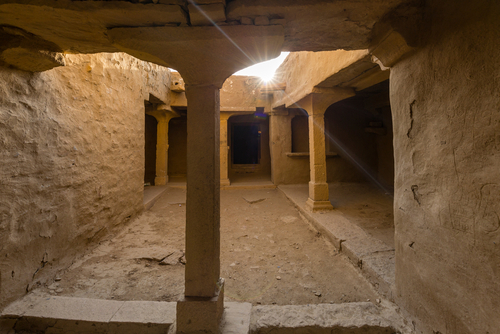
The village of Kuldhara, near Jaisalmer in the Thar Desert, was abandoned overnight in 1825 by its entire population of approximately 1,500 people, the Paliwal Brahmin community that had lived there for 500 years. They left without explanation. They never returned. The village has been uninhabited since.
Local legend attributes the abandonment to a curse laid on the village by its departing residents. Historians attribute it more prosaically to the oppressive taxation and alleged predatory behaviour of the regional diwan (administrator) toward the community’s women.
What to see: The ruins of the village, streets, house foundations, a central well, a temple, preserved in the dry desert air in a state of extraordinary completeness. Walking through Kuldhara at dawn, before other visitors arrive, in the silence of the desert, produces a quality of atmospheric unease that the legends around the place deliberately cultivate and that the archaeological reality genuinely supports.
Practical note: Kuldhara is 18 kilometres from Jaisalmer. The site is manageable as a half-day excursion combined with a Jaisalmer fort visit.
Wagah Border Ceremony – Punjab
The Wagah Border, the only road crossing between India and Pakistan, hosts a daily flag-lowering ceremony at sunset that is simultaneously a display of military pageantry, a patriotic spectacle, and one of the most viscerally charged border experiences available anywhere in the world.
Soldiers from both sides of the border perform an elaborate, choreographed retreat ceremony, high kicks, dramatic marching, aggressive facing-off, while crowds on both sides cheer their respective countries with extraordinary intensity. The ceremony ends with the simultaneous lowering of the Indian and Pakistani flags and the closing of the border gates.
The Wagah ceremony is not dark tourism in the conventional sense, no atrocity occurred here, and the ceremony is not solemn. But it is one of the most emotionally charged experiences available to an international visitor in India, a daily performance of a division that cost millions of lives and that continues to shape the subcontinent’s political reality seven decades later.
Practical note: The ceremony is held daily at sunset. Arrive at least 90 minutes early to secure a seat in the grandstand. The Indian side typically draws crowds of 10,000–15,000 people. Book a private vehicle from Amritsar, the ceremony is 30 kilometres from the city.
Practical Guide for Dark Tourism in India
Approach with respect. These are not theme parks. They are sites of genuine historical tragedy. Appropriate behaviour, quiet reflection, modest dress, restraint with photography, is both a courtesy and an ethical obligation.
Hire a specialist guide. The historical context of India’s dark tourism sites is complex and politically charged. A knowledgeable local guide who can explain the full context, including perspectives that official narratives sometimes omit, transforms the experience from observation into understanding.
Allow sufficient time. Dark tourism sites cannot be rushed. The Partition Museum requires 2–3 hours. The Cellular Jail requires a full half-day including the evening sound and light show. Jallianwala Bagh requires at least an hour of unhurried reflection.
Combine thoughtfully. The most rewarding dark tourism itinerary in India combines Amritsar, Jallianwala Bagh, the Partition Museum, the Golden Temple, and the Wagah Border, in a single 2-day visit. This combination covers colonial atrocity, Partition trauma, living religious tradition, and contemporary political division in a single geographic area of profound historical density.
Frequently Asked Questions
Is dark tourism in India appropriate for all visitors?
It is appropriate for any visitor who approaches these sites with genuine historical curiosity and respect. It is not appropriate for those seeking entertainment from tragedy. Children should be assessed individually, the Partition Museum is suitable for older teenagers with historical context preparation. The Cellular Jail is suitable for most ages with adult guidance.
Which is India’s most significant dark tourism site?
The Cellular Jail in Port Blair and Jallianwala Bagh in Amritsar are equally significant in different ways. The Cellular Jail represents the systematic brutality of colonial imprisonment over decades. Jallianwala Bagh represents a single act of colonial violence whose political consequences shaped the entire trajectory of Indian independence. Both are essential.
Can dark tourism sites be combined with standard India sightseeing?
Yes and this combination produces the most honest and most complete picture of India available to an international visitor. Amritsar combines Jallianwala Bagh with the Golden Temple. The Andaman Islands combine the Cellular Jail with Radhanagar Beach. Bhopal combines the gas tragedy memorial sites with Bhimbetka’s 30,000-year-old rock art.
Is photography permitted at dark tourism sites in India?
Generally yes, with sensitivity. Photography is permitted at the Cellular Jail, Jallianwala Bagh, and the Partition Museum, though flash photography and selfie-taking at memorial sites is widely considered disrespectful. Always follow posted guidelines and the advice of your guide.
India’s dark tourism sites are among the most historically significant and emotionally powerful in Asia, and visiting them properly requires historical context, the right guidance, and itineraries that give these places the time and attention they deserve. At GeTS Holidays, we build India itineraries that combine extraordinary cultural and heritage experiences with honest engagement with the country’s complex history, for travellers who want to understand India fully, not just see it. Begin at [www.getsholidays.com].